Affichage des articles dont le libellé est Edgar Froese. Afficher tous les articles

dimanche 17 décembre 2023

Patch Work Music from yesterday to today

The basic idea or concept behind PWM
could be summed up in one word: "Together".

Bertrand Loreau


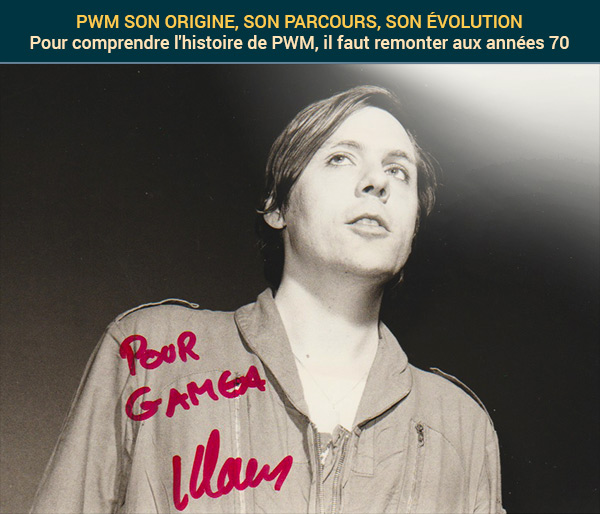
Une dédicace de Klaus Schulze pour GAMEA
A dedication from Klaus Schulze for GAMEA

PWM ITS ORIGINS, ITS PATH, ITS EVOLUTION
To understand the history of PWM,
you have to go back to the 70s

Sequentia Legenda : Can you tell us about the origins of Patch Work Musique? Its origins, its path, its evolution?

Bertrand Loreau : To understand the history of Patch Work Music (PWM), you have to go back to the 70s, when there was an association called les amis de Klaus Schulze, then GAMEA. This association brought together fans of the composer of Timewind, but not only. Christian Piednoir, Jean-Christophe Allier, Dominique Daviot and myself were active members of GAMEA (Groupe d'Animation Musicale Electronique d'Avenir).

GAMEA had had contacts with Klaus Schulze, thanks in particular to Pascal Bouchez, who was invited to Germany, with Klaus Dieter Mueller too, and finally with the Innovative Communication label. So in the early 80s I took it upon myself to import records from the IC label, created by Klaus Schulze, like the first Robert Schroeder records. In '82 or '83, this group of around 70 enthusiasts was struggling a bit, probably because we were young, students or people just starting out in the world of work, and we didn't have a lot of resources to organise or create projects. You have to remember what the world was like before the Internet: everything we could envisage doing involved exchanges by post and only, in extreme cases, by telephone, because communications outside the department were very expensive. It was still the early 80s when two members of GAMEA, Christian Jacob and Serge Leroy, wanted to create a new association that would develop GAMEA's activities with new ambitions. The creation of this new association was encouraged by the GAMEA board and its members were encouraged to join the new association: Crystal Lake. GAMEA was then dissolved. Olivier Briand, Lionel Palierne, Jean-Christophe, Christophe Martin, Michel Boegler, myself and others joined Crystal Lake and some of us even took part in a trip with Crystal Lake to Sheffield in 1985, to experience the UK Electronica electronic music festival, which enabled us to see or meet people like Mark Jenkins, Manuel Gottsching, Harald Grosskopf, Michel Huyen, Ian Boddy and Steve Joliffe.

You may also remember that musicians, including myself, who had been part of GAMEA, performed at a concert-festival in Chatenay Malabry, a day of electronic music organised by Crystal Lake, which introduced many people to the group Lightwave.

Bertrand Loreau - Chatenay Malabry concert 1985

In 1986, former GAMEA members and Crystal Lake members met up again at the Tangerine Dream concert at the Olympia, organised by the Parisian association, and had the chance to meet Edgar Froese, Chris Franke and Paul Haslinger.

It became clear after the Tangerine Dream concert that it marked the end of an era. Crystal Lake was developing its links with the Paris region, opening up more and more to new-age music, ambient, etc. and supporting the experimental music of Lightwave. Crystal Lake was gradually distancing itself from the fundamentals that people like Olivier Briand, Jean-Christophe and I were so keen on, and was increasingly favouring a fairly intellectual approach to electronic music which, in my opinion, was inappropriate for music that remains fundamentally simple, even when it is of high quality. Meanwhile, the passion for the synthesiser was still very much alive in the 80s in Nantes, and it was obvious that this effervescence would provoke initiatives. The first to take action was Nicolas Moreau, who decided to create the Association Pour La Recherche Musicale (A.P.R.M.). Nicolas, who was a musician as well as an engineer by training, had the idea of trying to bring together musicians from the world of classical music and that of the synthesiser, so that ideas for the invention of new instruments could be born. I have a vague recollection of a meeting with Christian Villeneuve, a composer and teacher at the Conservatoire.The A.P.R.M. organised an electronic music festival with concerts and an instrument showroom. (The Synthfest concept had already been invented.) Jean-Philippe Rykiel was invited to play, as were the groups Olaf Potorose (with Nicolas Moreau), Noa (with Christophe Poisson at EMS AKS), Krill (Lionel and Bertrand) and Didier Bocquet, who had released his first album. The festival, entitled 'Synthés Folie', was unique in that it took place over the course of an entire week, in several of Nantes' concert halls and in several of the city's districts. The Association Musique et Technologie (A.M.T.) was born a few months later with simpler ambitions, such as producing a fanzine and organising electronic music concerts. It published the journal AME and organised a concert day featuring a number of local personalities, including Christophe Martin de Montagu and his group Kito, Olivier Briand and his trio Synthax Error, and others. A.M.T. had a relatively short life, and the early 90s were characterised by a certain passivity on the part of Nantes' synthesiser enthusiasts. Olivier Briand and I had started producing records, notably with the MUSEA label, and we were probably concentrating a bit on ourselves. But something clicked when I read an article one day in 1994 or 1995 which tended to play down what Klaus Schulze had contributed to electronic music, and I rushed to Olivier Briand and told him: I rushed to Olivier Briand and told him: "I think we need to re-establish certain truths and to do that we need to recreate an association that will reaffirm the importance that Klaus Schulze has always had in electronic music, and which will say that he is the symbol of authenticity that inspires people of our generation of musicians. ". At the time, our friend Olivier Bégué was publishing the fanzine Rubycon, but in 1995 Olivier Briand and I agreed that the project of our new association would be a little different, promoting French productions as much as possible, without denying the influence of the real pioneers in the field of synthesizers.

Patch Work Music (PWM) was born and, in order to realise its ambitions, quickly set to work on a compilation album to affirm its project to promote French music. The association devoted a lot of energy to writing and distributing a high-quality fanzine: KS mag. The letters "KS" were a reference to Schulze, but also to "Keyboards and Sequencers".


Two years later, PWM had, unfortunately, fallen asleep. It was more than ten years before Olivier Briand, standing in my garden, told me he wanted PWM to wake up. His idea was for a website to sell our music online. Olivier was convinced that we had to take advantage of the new ways of consuming music, by making mp3 files available on the internet. Tired, or disillusioned with the work of the association, I eventually decided to follow Olivier in his project. I was going through a period of loss of musical inspiration and I thought that, after all, getting involved with and for others would give me the desire to create again. In the winter of 2009, I decided to invite a dozen or so musicians and friends to a meeting in August to validate the decision to create the PWM-Distrib website. We were counting on Samuel Vallé, musician and IT specialist, to build the site. Almost all the artists present agreed to share the cost of creating the site.
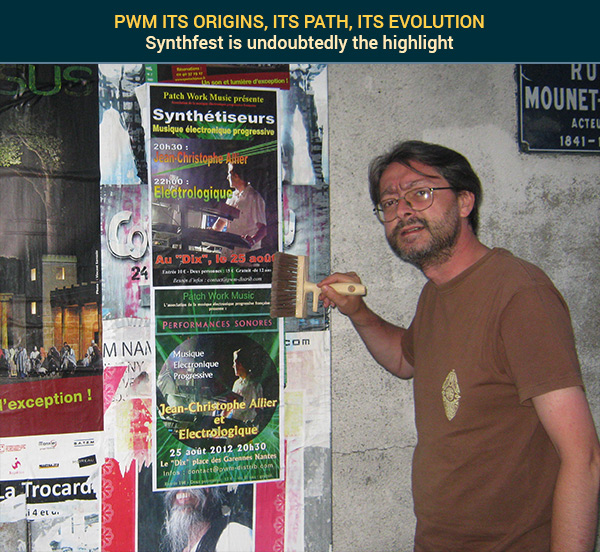
Synthfest 2012 Nantes
Olivier Briand - Synthfest 2012 in Nantes

The rest is history, with another milestone reached when PWM entrusted a complete overhaul of the site to David Perbal, also a musician and IT specialist. Patch Work Music also got back to producing newspapers. We created Minimag, La Lettre de Musique, Le Calepin, and the newspapers we know today. Synthfest is undoubtedly the culmination of a history of electronic music fan associations that began in the 70s, and which saw Klaus Schulze as the best representative of a certain conception of electronic music. However, while some people now see the festival as a celebration of electronic instruments, when I had the idea and laid the foundations for its organisation, the aim was for it to be a showcase for Patch Work Music, while also playing an educational and cultural role. When Olivier wanted the festival to be accompanied by concerts, we shared the idea that the festival should offer a stage to musicians who don't find many elsewhere. Today, the festival has taken a different direction, perhaps a necessary one, but its ambition is no longer the one we set out to achieve.

Synthfest 2016 Nantes
Synthfest 2016 in Nantes

PWM TODAY, ITS PHILOSOPHY, HOW IT WORKS
PWM could be summed up in one word: "Together"

Sequentia Legenda : Can you describe PWM today, its philosophy and how it works?

Bertrand Loreau : The basic idea or concept of PWM could be summed up in the word "Together". PWM would have no reason to exist if its project wasn't to bring together people who enjoy doing something together. Some people may think in terms of numbers: how many records do you sell? But is that what matters? I think the most important thing is to find in the association the listening, the desire, the sharing of emotions. The most important thing is not the figures, but the quality of the exchanges and the emulation that can come out of it. I often think that we can draw a parallel with what the Impressionist painters experienced at the beginning of the XXᵉ century. Founders of a school, they met, motivated each other together, I think. Was the most important thing for these painters to become celebrities or to advance their art?

Synthfest 2017 Nantes
Valentin at Synthfest 2017 in Nantes

WHAT COULD BE THE PWM OF THE FUTURE
Still looking ahead to great things

Sequentia Legenda : How do you see the association developing, its future, and what could the PWM of the future look like?

Bertrand Loreau : I think that Patch Work Music has done some great things, particularly with its publications, Synthfest, compilation albums and by supporting musicians to get them into international catalogues. While remaining attached to the physical record, I now believe that we need to diversify the means of staying in touch with fans of progressive electronic music so as not to disappear into the mass of available means of information. At the same time, however, I've always thought that it would be a mistake to try to please the many, at any price, by any means. I think that PWM will continue to exist if people feel that by going to PWM they are finding a certain kind of music and people who form a small community that defends a 'certain' kind of electronic music and certain values, such as the belief that nothing can replace the record that you take the time to discover.

I think that PWM will increasingly need to bring together musicians who are collectively involved in projects. Trying to adapt to current tastes by opening up to different genres would be the surest way of drowning in a plethora of offerings. On the other hand, I think we need to move beyond the idea that the common denominator between PWM musicians is the use of the synthesiser. Without going so far as to promote acoustic music, we can see that a musician who plays the piano is sometimes closer to the spirit of PWM than many people who play the modular synthesiser or the drum machine. For many people, electronic instruments have become toys. Playing electronic music is as much fun as playing tennis or Playstation.

At the moment I have an idea to create a PWM label, which would be a collaborative label. The idea would be to take the association's philosophy further. Perhaps PWM should also defend its identity - that of French progressive electronic music - by publishing works that go a bit further than a fanzine.

To conclude: I hope that others like myself will be leaders and manage projects. Motivation wears thin. Patch Work Music may come to an end tomorrow and its balance sheet will still be very positive, but it can still look forward to great things. You have to realise that anything that doesn't move forward, that doesn't take risks, that doesn't unite people around objectives is almost certain to disappear.

Sequentia Legenda : On behalf of all the musicians, I'd like to thank you very much for all the attention and energy you've shown, and for everything you've done for PWM.

(To the French version : https://sequentia-legenda.blogspot.com/2023/12/patch-work-music-dhier-aujourdhui.html)




   Facebook Sequentia Legenda   Pinterest Sequentia Legenda   Youtube Sequentia Legenda   Sequentia Legenda Official Website


samedi 16 décembre 2023

Patch Work Music d'hier à aujourd'hui

L'idée ou le concept de base de PWM
pourrait se résumer avec le mot : « Ensemble ».

Bertrand Loreau


Une dédicace de Klaus Schulze pour GAMEA

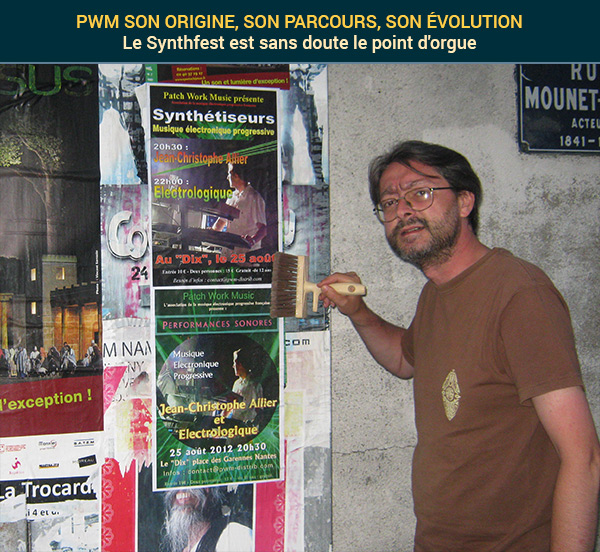
PWM SON ORIGINE, SON PARCOURS, SON ÉVOLUTION
Pour comprendre l'histoire de PWM,
il faut remonter aux années 70

Sequentia Legenda : Peux-tu nous parler de l’origine de Patch Work Musique ? Son origine, son parcours, son évolution ?

Bertrand Loreau : Pour comprendre l'histoire de Patch Work Music (PWM), il faut remonter aux années 70 au cours desquelles a existé une association qui s'est appelée les amis de Klaus Schulze, puis le GAMEA. Cette association réunissait des fans du compositeur de Timewind mais pas seulement. Christian Piednoir, Jean-Christophe Allier, Dominique Daviot, et moi-même, avons été des membres actifs du GAMEA (Groupe d'Animation Musicale Electronique d'Avenir).

Le GAMEA avait eu des contacts avec Klaus Schulze, grâce notamment à Pascal Bouchez, qui fut invité en Allemagne, avec Klaus Dieter Mueller aussi, puis finalement avec le label Innovative Communication. Ainsi je me suis chargé au début des années 80 d'importer des disques du label IC, créé par Klaus Schulze, comme les premiers Robert Schroeder. Dans les années 82 ou 83, ce groupe d'environ 70 passionnés végétait un peu cependant, sans doute parce que nous étions jeunes, étudiants, ou des gens qui entraient dans la vie active, et que nous n'avions pas beaucoup de moyens pour organiser ou créer des projets. Il faut se rappeler ce qu'était le monde d'avant internet : tout ce que nous pouvions envisager de faire impliquait des échanges par courrier postal et seulement, en cas extrême, par le téléphone, parce que les communications hors département coûtaient très chère. On était encore dans la première partie des années 80 quand deux membres du GAMEA, Christian Jacob et Serge Leroy, ont souhaité créer une nouvelle association qui développerait l'activité du GAMEA avec de nouvelles ambitions. La création de cette nouvelle association fut encouragée par le bureau du GAMEA et ses membres furent incités à rejoindre la nouvelle association : Crystal Lake. Le GAMEA fut alors dissout. Olivier Briand, Lionel Palierne, Jean-Christophe, Christophe Martin, Michel Boegler, moi-même, et d'autres, avons rejoint Crystal Lake et même, avons, pour certains d'entre nous, participé à un voyage avec Crystal Lake à Sheffield, en 1985, pour vivre le festival de musique électronique UK Electronica, qui nous permit de voir ou rencontrer des gens comme Mark Jenkins, Manuel Gottsching, Harald Grosskopf, Michel Huyen, Ian Boddy, Steve Joliffe.

On peut se rappeler aussi que des musiciens, dont moi-même, qui avaient fait partie du GAMEA, s'étaient produits dans un concert-festival à Chatenay Malabry, une journée de musique électronique organisée par Crystal Lake qui permit a beaucoup de découvrir le groupe Lightwave.

Bertrand Loreau - Chatenay Malabry concert 1985

En 1986 des anciens du GAMEA et des membres de Crystal Lake se retrouvèrent, une nouvelle fois, à l'occasion du concert de Tangerine Dream à l'Olympia, organisé par l'association parisienne, et eurent la chance de rencontrer Edgar Froese, Chris Franke et Paul Haslinger.


On comprit bien après le concert de Tangerine Dream que celui-ci avait marqué la fin d'une époque. Crystal Lake développait ses liens sur la région parisienne et s'ouvrait de plus en plus aux musiques new-age, ambient, etc. et soutenait la musique expérimentale de Lightwave. Crystal Lake prenait, progressivement, un peu de distance avec les fondamentaux auxquels des gens comme Olivier Briand, Jean-Christophe et moi tenions beaucoup, et privilégiait de plus en plus une approche assez intellectuelle de la musique électronique qui, selon moi, était inappropriée pour des musiques qui restent fondamentalement simples, même quand elles sont de qualité. Pendant ce temps là la passion du synthétiseur restait très vivante dans les années 80 à Nantes, et il était évident que cette effervescence provoquerait des initiatives. Celui qui tira le premier fut Nicolas Moreau qui décida la création de l'Association Pour La Recherche Musicale (A.P.R.M.). Nicolas, musicien, mais aussi ingénieur de formation, avait l'idée d'essayer de rapprocher les musiciens du monde classique de celui du synthétiseur pour que naissent des idées d'invention de nouveaux instruments. Je me souviens, vaguement, d'ailleurs, d'une rencontre avec le compositeur et professeur du conservatoire, Christian Villeneuve. L'A.P.R.M. organisa un festival de musique électronique avec des concerts et un lieu d'exposition d'instruments. (Le concept du Synthfest avait déjà été inventé.) Jean-Philippe Rykiel fut invité à jouer, ainsi que les groupes Olaf Potorose (avec Nicolas Moreau), Noa (avec Christophe Poisson à l'EMS AKS), Krill (Lionel et Bertrand) et Didier Bocquet qui avait sorti un premier disque. Le festival, intitulé « Synthés Folie », eut la particularité de se dérouler au cours de toute une semaine, dans plusieurs salles de concert de Nantes et dans plusieurs quartiers de la ville. L'Association Musique et Technologie (A.M.T.) est née quelques mois plus tard avec des ambitions plus simples comme celle de produire un fanzine et d'organiser des concerts de musique électronique. Elle publia le journal AME et organisa une journée-concert au cours duquel se succédèrent quelques personnalités locales, comme Christophe Martin de Montagu et son groupe Kito, Olivier Briand et son trio Synthax Error, etc. L'A.M.T. connut une vie assez courte et le début des années 90 fut caractérisé par une certaine passivité des passionnés nantais du synthétiseur. Olivier Briand et moi-même avions commencé à produire des disques, notamment avec le label MUSEA, et nous nous concentrions sans doute un peu sur nous-mêmes. Cependant un déclic se produisit avec la lecture d'un article, un jour de 1994 ou 1995, qui tendait à minimiser ce que Klaus Schulze avait apporté à la musique électronique et je me suis précipité voir Olivier Briand pour lui dire : « je crois qu'il faut rétablir certaines vérités et qu'il nous faut pour cela recréer une association qui réaffirmera l'importance qu'à toujours eu Klaus Schulze dans la musique électronique, et qui dira qu'il est le symbole de l'authenticité qui inspire les gens de notre génération de musicien.». A cette époque existait le fanzine Rubycon de notre ami Olivier Bégué mais, en 1995, avec Olivier Briand on a convenu que le projet de notre nouvelle association serait un peu différent en promouvant autant que possible les productions françaises, sans nier l'influence des vrais pionniers dans le domaine des synthétiseurs. 

Patch Work Music (PWM) était née et, pour concrétiser ses ambitions, a rapidement mis en chantier un disque compilation pour affirmer son projet de promouvoir la musique française. L'association a consacré beaucoup d'énergie à la rédaction et la diffusion d'un fanzine de haute qualité : KS mag. Les lettres « KS » faisaient référence à Schulze mais aussi à « Keyboards and Sequencers ».


Deux années, plus tard PWM s'est, malheureusement, comme endormie. Il se passa plus d'une dizaine d'années avant qu'Olivier Briand, dans mon jardin, me racontât son envie que PWM se réveille. Son idée était celle d'un site internet de vente en ligne de nos musiques. Olivier était persuadé que nous devions profiter des nouveaux modes de consommation de musique, par la mise à disposition de fichiers en mp3 sur internet. Fatigué, ou déçu du travail associatif, je finis cependant par me décider à suivre Olivier dans son projet. J'étais dans un moment de perte d'inspiration musicale et j'ai pensé, qu'après tout, se mobiliser avec, et pour les autres, me redonnerait l'envie de créer. Je décidai au cours de l'hiver 2009 d'inviter au mois d'août suivant une douzaine de musiciens environ, et des amis, pour valider la décision de créer le site PWM-Distrib. Nous comptions sur Samuel Vallé, musicien et informaticien, pour construire le site. Presque tous les artistes réunis acceptèrent ainsi l'idée de partager le coût de la création du site.

Synthfest 2012 Nantes
Olivier Briand - Synthfest 2012 à Nantes

Tout le monde connaît un peu la suite, avec notamment une autre étape franchie lorsque PWM confia une refonte complète du site à David Perbal, également musicien et informaticien. Patch Work Music a aussi renoué avec la production de journaux. On créa le Minimag, La Lettre de Musique, Le Calepin, et les journaux que l'on connait aujourd'hui. Le Synthfest est sans doute le point d'orgue d'une histoire d'association de fans de musique électronique qui a commencé dans les années 70, et qui voyait dans Klaus Schulze le meilleur représentant d'une certaine conception de la musique électronique. Cependant, si certains voient aujourd'hui le festival comme une fête des instruments électroniques, quand j'en ai eu l'idée et posé les bases de son organisation, l'objectif était qu'il soit une vitrine pour Patch Work Music, tout en jouant un rôle pédagogique et culturel. Quand Olivier souhaita que le festival soit accompagné de concerts, nous partagions l'idée que le festival devrait offrir une scène à des musiciens qui n'en trouvent pas beaucoup ailleurs. Aujourd'hui, le festival a pris une autre direction, peut-être nécessaire, mais son ambition n'est plus celle que nous nous étions donnée au départ.


Synthfest 2016 Nantes
Synthfest 2016 à Nantes

PWM AUJOURD’HUI, SA PHILOSOPHIE, SON FONCTIONNEMENT
PWM pourrait se résumer avec le mot : « Ensemble »

Sequentia Legenda : Peux-tu nous décrire PWM aujourd’hui, sa philosophie, son fonctionnement ?

Bertrand Loreau : L'idée ou le concept de base de PWM pourrait se résumer avec le mot : « Ensemble ». PWM n'aurait aucune raison d'exister si son projet n'était pas de réunir des gens qui ont du plaisir à faire quelque chose ensemble. Des gens peuvent raisonner en termes de chiffre ; combien de disques vendez-vous ? Mais est-ce cela l'essentiel ? Je crois que l'essentiel est de trouver dans l'association de l'écoute, de l'envie, du partage d'émotions. L'essentiel n'est pas dans les chiffres, mais dans la qualité des échanges et de l'émulation qui peut en sortir. Je pense, assez souvent, que l'on peut faire un parallèle avec à ce qu'ont vécu les peintres impressionnistes au début du XXᵉ siècle. Fondateurs d'une école, ils se rencontraient, se motivaient ensemble, je pense. Est-ce que le plus important pour ces peintres était de devenir des célébrités ou de faire avancer leur art ?


Synthfest 2017 Nantes
Valentin lors du Synthfest 2017 à Nantes

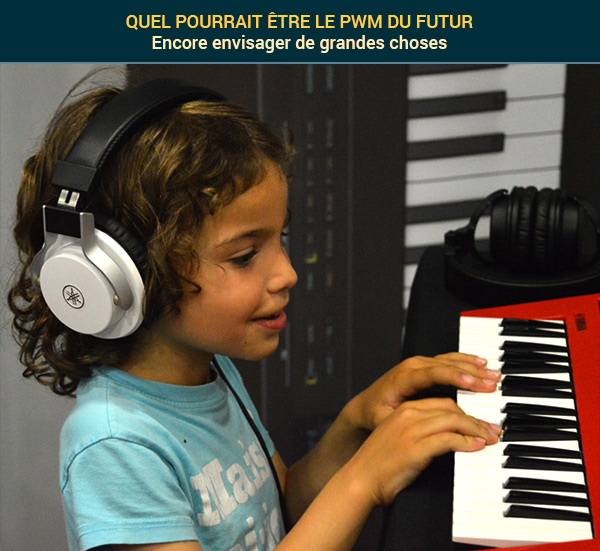
QUEL POURRAIT ÊTRE LE PWM DU FUTUR
Encore envisager de grandes choses

Sequentia Legenda : Comment vois-tu l’évolution de l’association, son avenir, quel pourrait être le PWM du futur ?

Bertrand Loreau : Je pense que Patch Work Music a fait de belles choses, notamment avec ses publications, le Synthfest, des disques compilation et en ayant accompagné des musiciens pour qu'ils entrent dans des catalogues internationaux. Tout en restant attaché au disque physique, je crois, maintenant, que l'on doit diversifier les moyens de rester en contact avec les fans de musique électronique progressive pour ne pas disparaître dans la masse des moyens disponibles de s'informer. J'ai toujours pensé, cependant, en même temps, que ce serait une erreur de vouloir plaire à beaucoup, à tout prix, par tous les moyens. Je pense que PWM continuera à exister si un public se dit qu'en allant chez PWM, il trouve un certain genre de musique et des gens qui forment une petite communauté qui défend une « certaine » musique électronique, certaines valeurs, comme celle de croire que rien ne remplace le disque que l'on prend du temps à découvrir.

Je crois qu'il faudra de plus en plus que PWM réunisse des musiciens qui s'investissent collectivement dans des projets. Vouloir s'adapter aux goûts actuels en s'ouvrant à des genres différents serait le plus sûr de se noyer dans une offre pléthorique. En revanche, je crois que l'on doit dépasser l'idée que le dénominateur commun entre les musiciens de PWM est l'utilisation du synthétiseur. Sans aller jusqu'à promouvoir des musiques acoustiques, on peut voir qu'un musicien qui joue du piano est parfois plus proche de l'esprit de PWM que bien des gens qui jouent du synthétiseur modulaire ou de la drum machine. Les instruments électroniques sont devenus pour beaucoup des jouets. On s'amuse à faire de la musique électronique, comme d'autres jouent au tennis ou à la playstation.

J'ai, en ce moment, une idée qui est la création d'un label PWM qui serait un label collaboratif. Il s'agirait de porter plus loin la philosophie de l'association. Peut-être que PWM devrait, aussi, défendre son identité - celle d'une musique électronique progressive française -, en publiant des ouvrages allant un peu plus loin qu'un fanzine.

Pour conclure : je souhaite que d'autres que moi soient des leaders et gèrent des projets. L'usure de la motivation nous guette tous. Patch Work Music peut s'arrêter demain et son bilan restera très positif, mais peut, aussi, encore envisager de grandes choses. Il faut se dire que ce qui n'avance pas, ne prend pas de risques, ne soude pas des gens sur des objectifs est à peu près sûr de disparaître.

Sequentia Legenda : Je te remercie infiniment au nom de tous les musiciens pour toute l'attention témoignée, l'énergie déployée, pour tout ce que tu as fait pour PWM.

(To the English version: https://sequentia-legenda.blogspot.com/2023/12/patch-work-music-from-yesterday-to-today.html)


   Facebook Sequentia Legenda   Pinterest Sequentia Legenda   Youtube Sequentia Legenda   Sequentia Legenda Official Website


samedi 11 avril 2020

FIVE - THE STORY - Five years Berlin School

Five first years on the Berlin School's stage


Sequentia Legenda Berlin School music
Thanks to Frank Heller for this photo

FIVE THE STORY

Dear Fellow listeners, Dear Fellow listeners,

The album "FIVE" celebrates my first five years on the Berlin School stage. During this time I have been fortunate to be able to share my own musical vision with passion and sincerity and to live my dream. This anniversary, it is with you, that I wish to share it here.

Take care of yourself and those around you, long live music, long live Love,
Laurent Schieber (Sequentia Legenda)
🎹😘🎹


Sequentia Legenda Berlin School music
Thanks to Alan Busby for this photo

BLUE DREAM BEGINNING OF MY MUSICAL ADVENTURE

The album "BLUE DREAM" released in December 2014 was the beginning of my musical adventure, other opus followed. Some albums were nominated for the Schallwelle Awards and I am proud and very happy about that. There was also the release of the double album "EXTENDED".

I had the privilege of meeting and dialoguing with musicians such as Thorsten Quaeschning, Bernd Kistenmacher, Harald Grosskopf, Bertrand Loreau, Olivier Briand to name but a few, and of collaborating with Tommy Betzler, Jean-Luc Briançon (Kurzt Mindfields), Michael Brückner (Live Session).


BLUE DREAM

Sequentia Legenda Berlin School music

MY SOUND UNIVERSES ON THE AIRWAVES

Radio moderators have not been outdone in broadcasting my sound worlds on the airwaves. I keep in memory some of the shows, for example "BLUE DREAM Trilogy" on SineFM with Simon Thomas, the moments in Jos verboven's show "Electronic Fusion", the memorable "Murmure du son" with the duo Sylvain Lupari and Robert Hamel, the appearances with Ecki Stieg in the unavoidable "Grenzwellen", without forgetting the programming in one of the most podcast radio shows in the world : "La Planète Bleue" by Yves Blanc. The show "Le Bunker" with for the occasion a two-hour "Special Sequentia Legenda" organized by Guy Devilla will also remain a superb moment of emotion for me.

I had the chance to express myself and share my passion during interviews, for example with Jean-Claude El Jice for an interview in the Belgian magazine "Le Progressiste". I remember my first interview in German and live via Skype in the "New Age" show with Rainer Tyson Schramke.


REVIEWS & INTERVIEWS

Sequentia Legenda Berlin School music

DIRECT AND PRIVILEGED CONTACT WITH THE LISTENERS

The stage performances in Germany, Switzerland and France were each time beautiful and rich experiences allowing me to have a direct and privileged contact with the listeners.

Here is the teaser produced by Guillaume Diard for Synthfest 2019:


Sequentia Legenda Berlin School music

UNEXPECTED PROJECTS WERE BORN

Unexpected projects were born, such as the participation in the book to read and listen to "La Lune, pourquoi on a décroché ?" by Lydia Mirdjanian in which my title "Solitudes Lunaires" was used as a soundtrack. I also think back to the Edgar Froese memorial project organized by Rebekkah Hilgraves. Surprises too, such as the presence of my track "AU REVOIR" in the La Planète Bleue volume 9 compilation, more information about it here.

There were also unfortunately some disappearances, I would come back here only on the premature departure of my friend Philipppe Vallin with whom I had a rich and warm contact. Phil had his own way of writing, an enlightened musical culture, a sensitivity that resembled me. One of Philippe Vallin's articles about me.


There have also been projects that could not be completed for various reasons, sometimes due to lack of time. The collaboration with Ron Charron (Kuutana Serenity) is still going on.

Some projects are in progress: the collaboration with the talented Hélène Vogelsinger, a concert project in a planetarium, a festival in Switzerland, my next album "BEYOND THE STARS".

And finally, to conclude this retrospective: During these five years, I have had the great pleasure to be able to benefit from the warm and unconditional support of the listeners whom I salute here. Thanks to all those who believed in my musical vision.


Laurent Schieber (Sequentia Legenda)
🎹😘🎹


TESTIMONIALS

Sequentia Legenda Berlin School music
Thanks to Beata Pardela for this photo

YOUR MUSIC IMMEDIATELY CAUGHT MY ATTENTION

I discovered your music at the end of 2018 on Bandcamp, and the first shot I heard was "MIND LAKE". As I am a great lover of electronic music, as well as the editor of the only Polish internet radio EL-Stacja promoting exclusively electronic music, your music immediately caught my attention. I am fascinated by the genre of the Berlin School and this style of music is the most important for me.
The music created has a gentle sequential structure that allows you to immerse yourself in your dreams, to think and above all to relax with it. For me, the moments spent with this music act as a balm for the soul, carry everyday problems somewhere far away and give great relaxation and the strength to struggle with reality. This music has a great calming and relaxing power and I am happy to listen to it.

Beata Pardela
(Radio Moderator - EL-Stacja - Poland)

🎙️ Beata Pardela asked a question to Sequentia Legenda: "I would like to know how your music has influenced you, how it has evolved over the last five years, when you have created so many really great and precious pieces, and how you evaluate your work in five years. What are your ideas and plans for the coming years?"

🎙️ Sequentia Legenda: "My influence goes back to my teenage years when I discovered Mirage Klaus Schulze's album by chance. That was my musical trigger. So it was much later, in 2014 with BLUE DREAM, that I took the plunge and brought my musical work into the open. Those first five years were pure joy as I was able to share my passion with success and recognition. I am proud and honoured. These first five years have been a pure joy in that I have been able to share my passion with success and recognition. My dream has come true and my next projects will be in this line with a constant evolution."


Sequentia Legenda Berlin School music

FIVE YEARS WHERE EVERY TIME I'M SURPRISED

For me it's five years where every time I'm surprised that you manage to surprise me. The challenges in your personal life perspire on the sweetness of your music. Even in its most intense moments. And this sensitivity that you lay down in music responds freshly to mine.

Sylvain Lupari
(Reviewer - Synth&Sequences)

🎙️ Sylvain Lupari asked a question to Sequentia Legenda: "Five years Laurent since BLUE DREAM! Are you satisfied with your evolution? How did you see yourself five years ago? Are you where you wanted to be?"

🎙️ Sequentia Legenda: "Time goes by quickly indeed, too quickly! I am a sensitive and demanding person with myself and I must admit without pretension that I am happy and satisfied with the journey I have made in five years. I have always favoured work, quality, rigour and sincerity. In the end, I am satisfied to find myself five years later in total adequacy with my musical vision of the start! I have made no concessions, I have kept the course I set myself and this is the one that will guide me for the next five years: sharing my sensitivity through my sound universes."


Sequentia Legenda Berlin School music
Thanks to Anton Uraletz for this photo

VAST SEAS OF HARMONIC SEQUENCES

My way to Berlin-school electronics was easy but long and took almost 20+ years since I heard it for the first time… there is so much interesting music around, and I explored it step by step, style by style. In the end of December 2015, a friend of mine gave me a tip to «BLUE DREAM» and «AMIRA» – «Man, you’ll like it… I swear». And yeah, I did. That was a sort of enlightenment – vast seas of harmonic sequences that set up a whole Universe of sound… the seas to immerse in, delving neither into psychedelic nor abstruse soundscapes. Straight-forward, simple and even sequencing is the remarkable and one of the most precious advantages of Sequentia Legenda… it forms these breezing soundscapes that carry you upwards and away on its wings of soaring dreams and reveries to the azure faraway distance where the Highmost Welkin meets the Sound of the Sequence. And that’s the way it is.

Anton Uraletz (Russia)

🎙️ Anton Uraletz asked a question to Sequentia Legenda: "My question about your last 5 years is simple – how have you fell in love with sequencing? What does it mean to you?"

🎙️ Sequentia Legenda: "I fell in love with the sequences from the very beginning of my discovery of Klaus Schulze's discography with the two sound universes of Mirage. The sequencer is my favourite tool, it is very often by the setting up of the loops that my creative work begins. The sequencer is my machine for weaving the soundtrack. It is important for me to make several loops of notes cohabit and to bring this harmonic and rhythmic ensemble to life.  My vision of sequencing: Loops in perpetual evolution."


Sequentia Legenda Berlin School music
Thanks to Oleg Parfentev for this photo

THE ART OF SEQUENTIA LEGENDA

I will start from a distance and tell you how I discovered electronic music and the Berlin school in particular.

...it was somewhere in the 90's, I don't remember exactly. I couldn't sleep at night, so I turned on the radio. There was beautiful, unusual music on the air, not like the music on other radio stations. I stayed on that show and listened to it until morning. Later I found out that it was a program about electronic music called Back to the Universe. Programmed at certain hours of the night, and its permanent host was (and still is) DJ, musician and journalist Martin Landers. Here is his website and information.

This man (his programs) took me into the world of electronic music, which I had never known before, and it was from him that I got to know the Berlin School and other areas of electronic music, Klaus Schulze and many other musicians and bands.

I heard the music of Sequentia Legenda for the first time 3 years ago on https://vk.com/ (it's our Russian analogue Facebook).

Only there you can put music in addition to texts, photos and videos. As a rule, it is pirated, which means that nobody pays for it. I really liked the songs (AU REVOIR, SOLITUDES LUNAIRES, THE APPROACH), and I kept them.

Much later, I decided to search the facebook page of Sequentia Legenda. And I had by chance the release of the new album OVER THERE, which of course I also liked a lot.

And then, Laurent, I recognized your blog, your page on bandcamp.com and all your music. And I also met you and made friends on facebook.

Each of your albums, I discovered it gradually : listen, listen, listen... They are different, but there is definitely a recognizable style, the style of Sequentia Legenda. Each album has a favourite track or even several. I also really like the way your CDs are made: the photo, the design and of course the sound. Thank you very much for your autographs and wishes. It's very expensive! In the age of digital sound, it's very nice to hold a CD (or a vinyl record) in your hands! (At least for me).

What does your music mean to me?
Laurent, for me, what you do on stage is magic. It's magical. I have no idea how it works! Yes, there's an idea, there are means and tools to implement it (synthesizers, computers, instruments). But how it all ends up in this fascinating music - I don't understand! And I don't have to understand it. Magic must contain mystery. But I MUCH like what you get in the end!

At the moment, for various reasons, I am not as actively following news and innovations in the field of music. But when I hear a melody on a radio station, I immediately recognize Sequentia Legenda. How do I feel? If something you like sounds like SOLITUDES LUNAIRES (one of the diamonds in your collection!), I'm delighted. The heart starts beating more often, breathtaking, you fly away... It's not in words!

In conclusion, I would like to thank you, Laurent, for the joy and happiness you bring to us, the listeners, with your magical music. You have always had and will always have a constant and faithful listener who needs you. Keep on creating. I know this is a difficult moment in your life, but let your two suns (Dylan and Valentin), as you once said, light your way and give you strength and confidence. You are a wonderful father, a wonderful musician and, in general, a kind and good person.

I am very happy to have met you and the art of Sequentia Legenda.

I wish you much, much luck and all the best!

Oleg
Parfentev (Russia)

🎙️ Oleg
Parfentev asked a question to Sequentia Legenda: "I'm interested in how the composition is born? Where does it begin? The very beginning. How do you put in your head this melody, this rhythm that will later be a success in your album? How does it happen? (I suspect that creating a melody is a long and tedious process (I might be wrong). But it always has a beginning, a starting point (a starting impulse). What does this mean to you? Share it, please, if you can share it :)"

🎙️ Sequentia Legenda: "The creative phase, begins in a subtle and unpredictable way, it's a call, a magnet that will attract me to my keyboards. Inspiration can come from an image, a story, a sound, a walk, a chance too. Then, in front of my machines, the experimental phase begins, often by setting up the first loops, then the first layers. Then begins the real work of composition, which can sometimes be time-consuming, because I am a demanding person - demanding on myself as well. For example, for my first track FLY OVER ME (BLUE DREAM), it took me no less than sixteen months to be satisfied with the result! Music is an achievement and I always want to put quality before quantity, I want to offer the best of myself for my listeners and for the beautiful musical movement that the Berlin School represents."


Google+ Sequentia Legenda    Facebook Sequentia Legenda   Pinterest Sequentia Legenda    Youtube Sequentia Legenda    Sequentia Legenda Official Website