Affichage des articles dont le libellé est Olivier Briand. Afficher tous les articles

dimanche 17 décembre 2023

Patch Work Music from yesterday to today

The basic idea or concept behind PWM
could be summed up in one word: "Together".

Bertrand Loreau


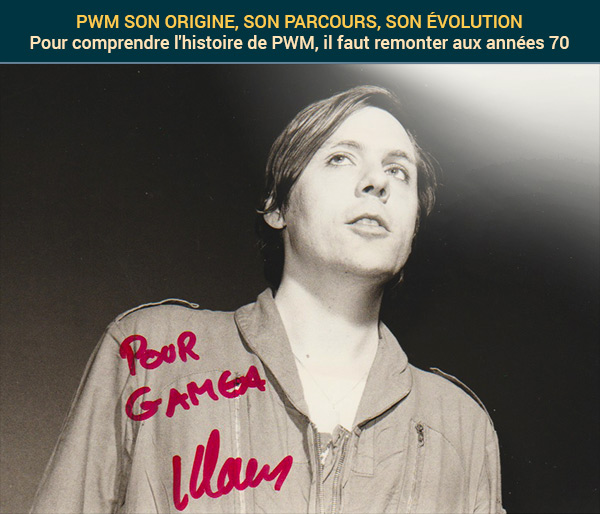
Une dédicace de Klaus Schulze pour GAMEA
A dedication from Klaus Schulze for GAMEA

PWM ITS ORIGINS, ITS PATH, ITS EVOLUTION
To understand the history of PWM,
you have to go back to the 70s

Sequentia Legenda : Can you tell us about the origins of Patch Work Musique? Its origins, its path, its evolution?

Bertrand Loreau : To understand the history of Patch Work Music (PWM), you have to go back to the 70s, when there was an association called les amis de Klaus Schulze, then GAMEA. This association brought together fans of the composer of Timewind, but not only. Christian Piednoir, Jean-Christophe Allier, Dominique Daviot and myself were active members of GAMEA (Groupe d'Animation Musicale Electronique d'Avenir).

GAMEA had had contacts with Klaus Schulze, thanks in particular to Pascal Bouchez, who was invited to Germany, with Klaus Dieter Mueller too, and finally with the Innovative Communication label. So in the early 80s I took it upon myself to import records from the IC label, created by Klaus Schulze, like the first Robert Schroeder records. In '82 or '83, this group of around 70 enthusiasts was struggling a bit, probably because we were young, students or people just starting out in the world of work, and we didn't have a lot of resources to organise or create projects. You have to remember what the world was like before the Internet: everything we could envisage doing involved exchanges by post and only, in extreme cases, by telephone, because communications outside the department were very expensive. It was still the early 80s when two members of GAMEA, Christian Jacob and Serge Leroy, wanted to create a new association that would develop GAMEA's activities with new ambitions. The creation of this new association was encouraged by the GAMEA board and its members were encouraged to join the new association: Crystal Lake. GAMEA was then dissolved. Olivier Briand, Lionel Palierne, Jean-Christophe, Christophe Martin, Michel Boegler, myself and others joined Crystal Lake and some of us even took part in a trip with Crystal Lake to Sheffield in 1985, to experience the UK Electronica electronic music festival, which enabled us to see or meet people like Mark Jenkins, Manuel Gottsching, Harald Grosskopf, Michel Huyen, Ian Boddy and Steve Joliffe.

You may also remember that musicians, including myself, who had been part of GAMEA, performed at a concert-festival in Chatenay Malabry, a day of electronic music organised by Crystal Lake, which introduced many people to the group Lightwave.

Bertrand Loreau - Chatenay Malabry concert 1985

In 1986, former GAMEA members and Crystal Lake members met up again at the Tangerine Dream concert at the Olympia, organised by the Parisian association, and had the chance to meet Edgar Froese, Chris Franke and Paul Haslinger.

It became clear after the Tangerine Dream concert that it marked the end of an era. Crystal Lake was developing its links with the Paris region, opening up more and more to new-age music, ambient, etc. and supporting the experimental music of Lightwave. Crystal Lake was gradually distancing itself from the fundamentals that people like Olivier Briand, Jean-Christophe and I were so keen on, and was increasingly favouring a fairly intellectual approach to electronic music which, in my opinion, was inappropriate for music that remains fundamentally simple, even when it is of high quality. Meanwhile, the passion for the synthesiser was still very much alive in the 80s in Nantes, and it was obvious that this effervescence would provoke initiatives. The first to take action was Nicolas Moreau, who decided to create the Association Pour La Recherche Musicale (A.P.R.M.). Nicolas, who was a musician as well as an engineer by training, had the idea of trying to bring together musicians from the world of classical music and that of the synthesiser, so that ideas for the invention of new instruments could be born. I have a vague recollection of a meeting with Christian Villeneuve, a composer and teacher at the Conservatoire.The A.P.R.M. organised an electronic music festival with concerts and an instrument showroom. (The Synthfest concept had already been invented.) Jean-Philippe Rykiel was invited to play, as were the groups Olaf Potorose (with Nicolas Moreau), Noa (with Christophe Poisson at EMS AKS), Krill (Lionel and Bertrand) and Didier Bocquet, who had released his first album. The festival, entitled 'Synthés Folie', was unique in that it took place over the course of an entire week, in several of Nantes' concert halls and in several of the city's districts. The Association Musique et Technologie (A.M.T.) was born a few months later with simpler ambitions, such as producing a fanzine and organising electronic music concerts. It published the journal AME and organised a concert day featuring a number of local personalities, including Christophe Martin de Montagu and his group Kito, Olivier Briand and his trio Synthax Error, and others. A.M.T. had a relatively short life, and the early 90s were characterised by a certain passivity on the part of Nantes' synthesiser enthusiasts. Olivier Briand and I had started producing records, notably with the MUSEA label, and we were probably concentrating a bit on ourselves. But something clicked when I read an article one day in 1994 or 1995 which tended to play down what Klaus Schulze had contributed to electronic music, and I rushed to Olivier Briand and told him: I rushed to Olivier Briand and told him: "I think we need to re-establish certain truths and to do that we need to recreate an association that will reaffirm the importance that Klaus Schulze has always had in electronic music, and which will say that he is the symbol of authenticity that inspires people of our generation of musicians. ". At the time, our friend Olivier Bégué was publishing the fanzine Rubycon, but in 1995 Olivier Briand and I agreed that the project of our new association would be a little different, promoting French productions as much as possible, without denying the influence of the real pioneers in the field of synthesizers.

Patch Work Music (PWM) was born and, in order to realise its ambitions, quickly set to work on a compilation album to affirm its project to promote French music. The association devoted a lot of energy to writing and distributing a high-quality fanzine: KS mag. The letters "KS" were a reference to Schulze, but also to "Keyboards and Sequencers".


Two years later, PWM had, unfortunately, fallen asleep. It was more than ten years before Olivier Briand, standing in my garden, told me he wanted PWM to wake up. His idea was for a website to sell our music online. Olivier was convinced that we had to take advantage of the new ways of consuming music, by making mp3 files available on the internet. Tired, or disillusioned with the work of the association, I eventually decided to follow Olivier in his project. I was going through a period of loss of musical inspiration and I thought that, after all, getting involved with and for others would give me the desire to create again. In the winter of 2009, I decided to invite a dozen or so musicians and friends to a meeting in August to validate the decision to create the PWM-Distrib website. We were counting on Samuel Vallé, musician and IT specialist, to build the site. Almost all the artists present agreed to share the cost of creating the site.
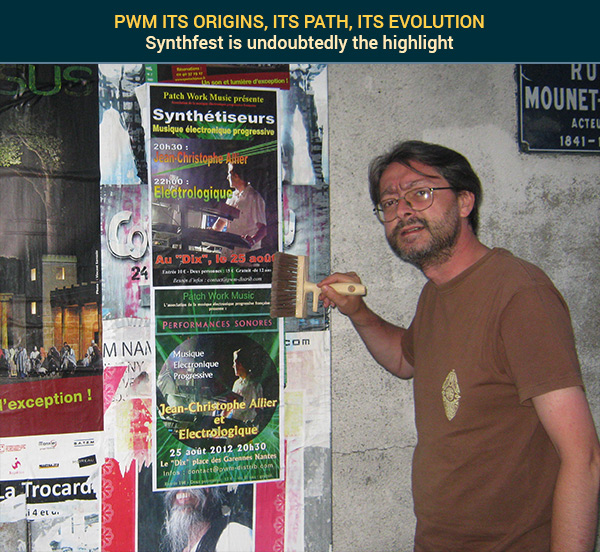
Synthfest 2012 Nantes
Olivier Briand - Synthfest 2012 in Nantes

The rest is history, with another milestone reached when PWM entrusted a complete overhaul of the site to David Perbal, also a musician and IT specialist. Patch Work Music also got back to producing newspapers. We created Minimag, La Lettre de Musique, Le Calepin, and the newspapers we know today. Synthfest is undoubtedly the culmination of a history of electronic music fan associations that began in the 70s, and which saw Klaus Schulze as the best representative of a certain conception of electronic music. However, while some people now see the festival as a celebration of electronic instruments, when I had the idea and laid the foundations for its organisation, the aim was for it to be a showcase for Patch Work Music, while also playing an educational and cultural role. When Olivier wanted the festival to be accompanied by concerts, we shared the idea that the festival should offer a stage to musicians who don't find many elsewhere. Today, the festival has taken a different direction, perhaps a necessary one, but its ambition is no longer the one we set out to achieve.

Synthfest 2016 Nantes
Synthfest 2016 in Nantes

PWM TODAY, ITS PHILOSOPHY, HOW IT WORKS
PWM could be summed up in one word: "Together"

Sequentia Legenda : Can you describe PWM today, its philosophy and how it works?

Bertrand Loreau : The basic idea or concept of PWM could be summed up in the word "Together". PWM would have no reason to exist if its project wasn't to bring together people who enjoy doing something together. Some people may think in terms of numbers: how many records do you sell? But is that what matters? I think the most important thing is to find in the association the listening, the desire, the sharing of emotions. The most important thing is not the figures, but the quality of the exchanges and the emulation that can come out of it. I often think that we can draw a parallel with what the Impressionist painters experienced at the beginning of the XXᵉ century. Founders of a school, they met, motivated each other together, I think. Was the most important thing for these painters to become celebrities or to advance their art?

Synthfest 2017 Nantes
Valentin at Synthfest 2017 in Nantes

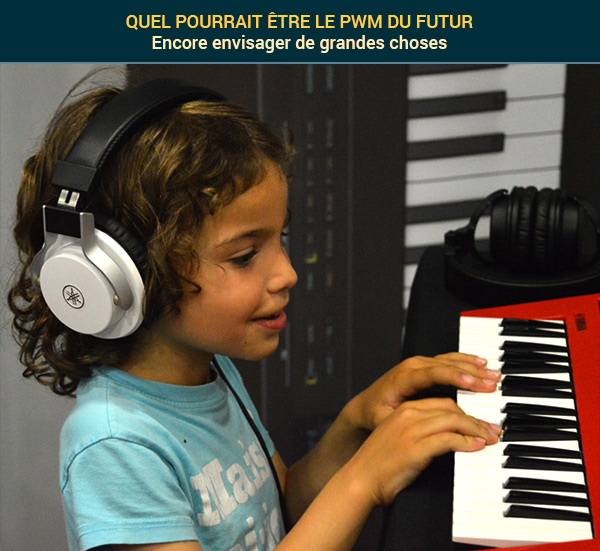
WHAT COULD BE THE PWM OF THE FUTURE
Still looking ahead to great things

Sequentia Legenda : How do you see the association developing, its future, and what could the PWM of the future look like?

Bertrand Loreau : I think that Patch Work Music has done some great things, particularly with its publications, Synthfest, compilation albums and by supporting musicians to get them into international catalogues. While remaining attached to the physical record, I now believe that we need to diversify the means of staying in touch with fans of progressive electronic music so as not to disappear into the mass of available means of information. At the same time, however, I've always thought that it would be a mistake to try to please the many, at any price, by any means. I think that PWM will continue to exist if people feel that by going to PWM they are finding a certain kind of music and people who form a small community that defends a 'certain' kind of electronic music and certain values, such as the belief that nothing can replace the record that you take the time to discover.

I think that PWM will increasingly need to bring together musicians who are collectively involved in projects. Trying to adapt to current tastes by opening up to different genres would be the surest way of drowning in a plethora of offerings. On the other hand, I think we need to move beyond the idea that the common denominator between PWM musicians is the use of the synthesiser. Without going so far as to promote acoustic music, we can see that a musician who plays the piano is sometimes closer to the spirit of PWM than many people who play the modular synthesiser or the drum machine. For many people, electronic instruments have become toys. Playing electronic music is as much fun as playing tennis or Playstation.

At the moment I have an idea to create a PWM label, which would be a collaborative label. The idea would be to take the association's philosophy further. Perhaps PWM should also defend its identity - that of French progressive electronic music - by publishing works that go a bit further than a fanzine.

To conclude: I hope that others like myself will be leaders and manage projects. Motivation wears thin. Patch Work Music may come to an end tomorrow and its balance sheet will still be very positive, but it can still look forward to great things. You have to realise that anything that doesn't move forward, that doesn't take risks, that doesn't unite people around objectives is almost certain to disappear.

Sequentia Legenda : On behalf of all the musicians, I'd like to thank you very much for all the attention and energy you've shown, and for everything you've done for PWM.

(To the French version : https://sequentia-legenda.blogspot.com/2023/12/patch-work-music-dhier-aujourdhui.html)




   Facebook Sequentia Legenda   Pinterest Sequentia Legenda   Youtube Sequentia Legenda   Sequentia Legenda Official Website


samedi 16 décembre 2023

Patch Work Music d'hier à aujourd'hui

L'idée ou le concept de base de PWM
pourrait se résumer avec le mot : « Ensemble ».

Bertrand Loreau


Une dédicace de Klaus Schulze pour GAMEA

PWM SON ORIGINE, SON PARCOURS, SON ÉVOLUTION
Pour comprendre l'histoire de PWM,
il faut remonter aux années 70

Sequentia Legenda : Peux-tu nous parler de l’origine de Patch Work Musique ? Son origine, son parcours, son évolution ?

Bertrand Loreau : Pour comprendre l'histoire de Patch Work Music (PWM), il faut remonter aux années 70 au cours desquelles a existé une association qui s'est appelée les amis de Klaus Schulze, puis le GAMEA. Cette association réunissait des fans du compositeur de Timewind mais pas seulement. Christian Piednoir, Jean-Christophe Allier, Dominique Daviot, et moi-même, avons été des membres actifs du GAMEA (Groupe d'Animation Musicale Electronique d'Avenir).

Le GAMEA avait eu des contacts avec Klaus Schulze, grâce notamment à Pascal Bouchez, qui fut invité en Allemagne, avec Klaus Dieter Mueller aussi, puis finalement avec le label Innovative Communication. Ainsi je me suis chargé au début des années 80 d'importer des disques du label IC, créé par Klaus Schulze, comme les premiers Robert Schroeder. Dans les années 82 ou 83, ce groupe d'environ 70 passionnés végétait un peu cependant, sans doute parce que nous étions jeunes, étudiants, ou des gens qui entraient dans la vie active, et que nous n'avions pas beaucoup de moyens pour organiser ou créer des projets. Il faut se rappeler ce qu'était le monde d'avant internet : tout ce que nous pouvions envisager de faire impliquait des échanges par courrier postal et seulement, en cas extrême, par le téléphone, parce que les communications hors département coûtaient très chère. On était encore dans la première partie des années 80 quand deux membres du GAMEA, Christian Jacob et Serge Leroy, ont souhaité créer une nouvelle association qui développerait l'activité du GAMEA avec de nouvelles ambitions. La création de cette nouvelle association fut encouragée par le bureau du GAMEA et ses membres furent incités à rejoindre la nouvelle association : Crystal Lake. Le GAMEA fut alors dissout. Olivier Briand, Lionel Palierne, Jean-Christophe, Christophe Martin, Michel Boegler, moi-même, et d'autres, avons rejoint Crystal Lake et même, avons, pour certains d'entre nous, participé à un voyage avec Crystal Lake à Sheffield, en 1985, pour vivre le festival de musique électronique UK Electronica, qui nous permit de voir ou rencontrer des gens comme Mark Jenkins, Manuel Gottsching, Harald Grosskopf, Michel Huyen, Ian Boddy, Steve Joliffe.

On peut se rappeler aussi que des musiciens, dont moi-même, qui avaient fait partie du GAMEA, s'étaient produits dans un concert-festival à Chatenay Malabry, une journée de musique électronique organisée par Crystal Lake qui permit a beaucoup de découvrir le groupe Lightwave.

Bertrand Loreau - Chatenay Malabry concert 1985

En 1986 des anciens du GAMEA et des membres de Crystal Lake se retrouvèrent, une nouvelle fois, à l'occasion du concert de Tangerine Dream à l'Olympia, organisé par l'association parisienne, et eurent la chance de rencontrer Edgar Froese, Chris Franke et Paul Haslinger.


On comprit bien après le concert de Tangerine Dream que celui-ci avait marqué la fin d'une époque. Crystal Lake développait ses liens sur la région parisienne et s'ouvrait de plus en plus aux musiques new-age, ambient, etc. et soutenait la musique expérimentale de Lightwave. Crystal Lake prenait, progressivement, un peu de distance avec les fondamentaux auxquels des gens comme Olivier Briand, Jean-Christophe et moi tenions beaucoup, et privilégiait de plus en plus une approche assez intellectuelle de la musique électronique qui, selon moi, était inappropriée pour des musiques qui restent fondamentalement simples, même quand elles sont de qualité. Pendant ce temps là la passion du synthétiseur restait très vivante dans les années 80 à Nantes, et il était évident que cette effervescence provoquerait des initiatives. Celui qui tira le premier fut Nicolas Moreau qui décida la création de l'Association Pour La Recherche Musicale (A.P.R.M.). Nicolas, musicien, mais aussi ingénieur de formation, avait l'idée d'essayer de rapprocher les musiciens du monde classique de celui du synthétiseur pour que naissent des idées d'invention de nouveaux instruments. Je me souviens, vaguement, d'ailleurs, d'une rencontre avec le compositeur et professeur du conservatoire, Christian Villeneuve. L'A.P.R.M. organisa un festival de musique électronique avec des concerts et un lieu d'exposition d'instruments. (Le concept du Synthfest avait déjà été inventé.) Jean-Philippe Rykiel fut invité à jouer, ainsi que les groupes Olaf Potorose (avec Nicolas Moreau), Noa (avec Christophe Poisson à l'EMS AKS), Krill (Lionel et Bertrand) et Didier Bocquet qui avait sorti un premier disque. Le festival, intitulé « Synthés Folie », eut la particularité de se dérouler au cours de toute une semaine, dans plusieurs salles de concert de Nantes et dans plusieurs quartiers de la ville. L'Association Musique et Technologie (A.M.T.) est née quelques mois plus tard avec des ambitions plus simples comme celle de produire un fanzine et d'organiser des concerts de musique électronique. Elle publia le journal AME et organisa une journée-concert au cours duquel se succédèrent quelques personnalités locales, comme Christophe Martin de Montagu et son groupe Kito, Olivier Briand et son trio Synthax Error, etc. L'A.M.T. connut une vie assez courte et le début des années 90 fut caractérisé par une certaine passivité des passionnés nantais du synthétiseur. Olivier Briand et moi-même avions commencé à produire des disques, notamment avec le label MUSEA, et nous nous concentrions sans doute un peu sur nous-mêmes. Cependant un déclic se produisit avec la lecture d'un article, un jour de 1994 ou 1995, qui tendait à minimiser ce que Klaus Schulze avait apporté à la musique électronique et je me suis précipité voir Olivier Briand pour lui dire : « je crois qu'il faut rétablir certaines vérités et qu'il nous faut pour cela recréer une association qui réaffirmera l'importance qu'à toujours eu Klaus Schulze dans la musique électronique, et qui dira qu'il est le symbole de l'authenticité qui inspire les gens de notre génération de musicien.». A cette époque existait le fanzine Rubycon de notre ami Olivier Bégué mais, en 1995, avec Olivier Briand on a convenu que le projet de notre nouvelle association serait un peu différent en promouvant autant que possible les productions françaises, sans nier l'influence des vrais pionniers dans le domaine des synthétiseurs. 

Patch Work Music (PWM) était née et, pour concrétiser ses ambitions, a rapidement mis en chantier un disque compilation pour affirmer son projet de promouvoir la musique française. L'association a consacré beaucoup d'énergie à la rédaction et la diffusion d'un fanzine de haute qualité : KS mag. Les lettres « KS » faisaient référence à Schulze mais aussi à « Keyboards and Sequencers ».


Deux années, plus tard PWM s'est, malheureusement, comme endormie. Il se passa plus d'une dizaine d'années avant qu'Olivier Briand, dans mon jardin, me racontât son envie que PWM se réveille. Son idée était celle d'un site internet de vente en ligne de nos musiques. Olivier était persuadé que nous devions profiter des nouveaux modes de consommation de musique, par la mise à disposition de fichiers en mp3 sur internet. Fatigué, ou déçu du travail associatif, je finis cependant par me décider à suivre Olivier dans son projet. J'étais dans un moment de perte d'inspiration musicale et j'ai pensé, qu'après tout, se mobiliser avec, et pour les autres, me redonnerait l'envie de créer. Je décidai au cours de l'hiver 2009 d'inviter au mois d'août suivant une douzaine de musiciens environ, et des amis, pour valider la décision de créer le site PWM-Distrib. Nous comptions sur Samuel Vallé, musicien et informaticien, pour construire le site. Presque tous les artistes réunis acceptèrent ainsi l'idée de partager le coût de la création du site.

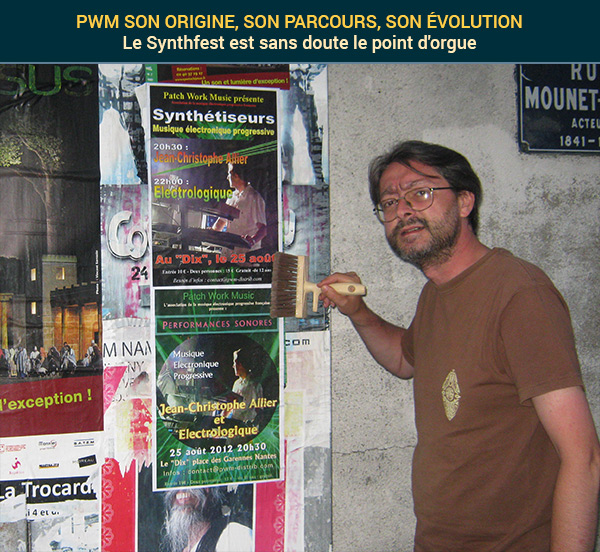
Synthfest 2012 Nantes
Olivier Briand - Synthfest 2012 à Nantes

Tout le monde connaît un peu la suite, avec notamment une autre étape franchie lorsque PWM confia une refonte complète du site à David Perbal, également musicien et informaticien. Patch Work Music a aussi renoué avec la production de journaux. On créa le Minimag, La Lettre de Musique, Le Calepin, et les journaux que l'on connait aujourd'hui. Le Synthfest est sans doute le point d'orgue d'une histoire d'association de fans de musique électronique qui a commencé dans les années 70, et qui voyait dans Klaus Schulze le meilleur représentant d'une certaine conception de la musique électronique. Cependant, si certains voient aujourd'hui le festival comme une fête des instruments électroniques, quand j'en ai eu l'idée et posé les bases de son organisation, l'objectif était qu'il soit une vitrine pour Patch Work Music, tout en jouant un rôle pédagogique et culturel. Quand Olivier souhaita que le festival soit accompagné de concerts, nous partagions l'idée que le festival devrait offrir une scène à des musiciens qui n'en trouvent pas beaucoup ailleurs. Aujourd'hui, le festival a pris une autre direction, peut-être nécessaire, mais son ambition n'est plus celle que nous nous étions donnée au départ.


Synthfest 2016 Nantes
Synthfest 2016 à Nantes

PWM AUJOURD’HUI, SA PHILOSOPHIE, SON FONCTIONNEMENT
PWM pourrait se résumer avec le mot : « Ensemble »

Sequentia Legenda : Peux-tu nous décrire PWM aujourd’hui, sa philosophie, son fonctionnement ?

Bertrand Loreau : L'idée ou le concept de base de PWM pourrait se résumer avec le mot : « Ensemble ». PWM n'aurait aucune raison d'exister si son projet n'était pas de réunir des gens qui ont du plaisir à faire quelque chose ensemble. Des gens peuvent raisonner en termes de chiffre ; combien de disques vendez-vous ? Mais est-ce cela l'essentiel ? Je crois que l'essentiel est de trouver dans l'association de l'écoute, de l'envie, du partage d'émotions. L'essentiel n'est pas dans les chiffres, mais dans la qualité des échanges et de l'émulation qui peut en sortir. Je pense, assez souvent, que l'on peut faire un parallèle avec à ce qu'ont vécu les peintres impressionnistes au début du XXᵉ siècle. Fondateurs d'une école, ils se rencontraient, se motivaient ensemble, je pense. Est-ce que le plus important pour ces peintres était de devenir des célébrités ou de faire avancer leur art ?


Synthfest 2017 Nantes
Valentin lors du Synthfest 2017 à Nantes

QUEL POURRAIT ÊTRE LE PWM DU FUTUR
Encore envisager de grandes choses

Sequentia Legenda : Comment vois-tu l’évolution de l’association, son avenir, quel pourrait être le PWM du futur ?

Bertrand Loreau : Je pense que Patch Work Music a fait de belles choses, notamment avec ses publications, le Synthfest, des disques compilation et en ayant accompagné des musiciens pour qu'ils entrent dans des catalogues internationaux. Tout en restant attaché au disque physique, je crois, maintenant, que l'on doit diversifier les moyens de rester en contact avec les fans de musique électronique progressive pour ne pas disparaître dans la masse des moyens disponibles de s'informer. J'ai toujours pensé, cependant, en même temps, que ce serait une erreur de vouloir plaire à beaucoup, à tout prix, par tous les moyens. Je pense que PWM continuera à exister si un public se dit qu'en allant chez PWM, il trouve un certain genre de musique et des gens qui forment une petite communauté qui défend une « certaine » musique électronique, certaines valeurs, comme celle de croire que rien ne remplace le disque que l'on prend du temps à découvrir.

Je crois qu'il faudra de plus en plus que PWM réunisse des musiciens qui s'investissent collectivement dans des projets. Vouloir s'adapter aux goûts actuels en s'ouvrant à des genres différents serait le plus sûr de se noyer dans une offre pléthorique. En revanche, je crois que l'on doit dépasser l'idée que le dénominateur commun entre les musiciens de PWM est l'utilisation du synthétiseur. Sans aller jusqu'à promouvoir des musiques acoustiques, on peut voir qu'un musicien qui joue du piano est parfois plus proche de l'esprit de PWM que bien des gens qui jouent du synthétiseur modulaire ou de la drum machine. Les instruments électroniques sont devenus pour beaucoup des jouets. On s'amuse à faire de la musique électronique, comme d'autres jouent au tennis ou à la playstation.

J'ai, en ce moment, une idée qui est la création d'un label PWM qui serait un label collaboratif. Il s'agirait de porter plus loin la philosophie de l'association. Peut-être que PWM devrait, aussi, défendre son identité - celle d'une musique électronique progressive française -, en publiant des ouvrages allant un peu plus loin qu'un fanzine.

Pour conclure : je souhaite que d'autres que moi soient des leaders et gèrent des projets. L'usure de la motivation nous guette tous. Patch Work Music peut s'arrêter demain et son bilan restera très positif, mais peut, aussi, encore envisager de grandes choses. Il faut se dire que ce qui n'avance pas, ne prend pas de risques, ne soude pas des gens sur des objectifs est à peu près sûr de disparaître.

Sequentia Legenda : Je te remercie infiniment au nom de tous les musiciens pour toute l'attention témoignée, l'énergie déployée, pour tout ce que tu as fait pour PWM.

(To the English version: https://sequentia-legenda.blogspot.com/2023/12/patch-work-music-from-yesterday-to-today.html)


   Facebook Sequentia Legenda   Pinterest Sequentia Legenda   Youtube Sequentia Legenda   Sequentia Legenda Official Website


jeudi 20 avril 2017

Interview with Sequentia Legenda by Philippe Vallin

Interview with Sequentia Legenda by Philippe Vallin

(Clair et Obscur, )


Interview de Sequentia Legenda par Philippe Vallin

Sequentia Legenda : an ever-expanding musical world…


Philippe Vallin: "Coming from a far distant blue planet somewhere in the depths of our galaxy, Laurent Schieber (aka Sequentia Legenda) came to visit us Terrians two years ago only, with his excellent first album entitled Blue Dream. After landing on our little biosphere, this lover of synthesizers and 'Berlin School'-like spacey electronic music kept on making us travel in our inner cosmos, thanks to his well crafted work, strongly influenced by the master Klaus Schulze, whose footsteps he proudly treads in. We have met and interviewed this dedicated composer, whose aesthetics is halfway between tradition and modernity, within a musical genre that is far from having bade its farewell…"


C&O :
Hi Laurent. You seem to play synthesizers and other sequencers for some time now. Where does this passion for « Berlin School » electronic music come from, and how to explain that Sequentia Legenda and his outstanding first album Blue Dream went to be issued in 2015 only ?

Sequentia Legenda : "It all started while listening to Klaus Schulze's album Mirage, when I was in my fifteens. I instantly fell in love with this music. This is how my love of Berlin School started. Since then, I kept on playing synthesizers. My music theory education and keyboard classes started in the back shop of a music store of my city. Soon my teacher realized how much I was interested in synthetic sounds, and music theory gave way to synthesizers' discovery. I was given the opportunity to handle the potentiometers of a mythical instrument: the famous Minimoog!

Years passed, and with them I purchased many electronic instruments. I started with analogical synthesizers such as Korg PS3200, ARP Odyssey, Crumar Multiman S, Oberheim Two VoiceKorg MS20 and its sequencer SQ10, Polymoog, Roland SVC-350 vocoder. When MIDI appeared, I got rid of all the analogical stuff to step in the digital era with my first MAO software running on an Atari 1024 STF, together with new machines such as DSS1 Korg, TG77 YamahaD110 Roland, Microwave Waldorf, K1M Kawai, and JD800 Roland.


Sequentia Legenda and analog synthesizers
Sequentia Legenda (Laurent Schieber) and analog synths. The Korg PS3200, Oberheim Two Voices, Crumar MultimanS, ARP Odyssey, Korg MS20 + SQ10 and more.
 
For a short period of time, I used to play keyboards for a local rock band. However, I prefered to play alone, training in the basement of my parents' house. The commercial music of the 80's hadn't any appeal on me. Spacey music was for me the musical path I wanted to follow. Therefore, I took the plunge only very recently. It became obvious that I had to unveil my work. I wanted to share with the world my musical vision and, through these compositions, also part of me. My first album Blue Dream was finalized end of 2014, after working for 16 months on it. I am a rigorous person, and this is one of the reasons why my first album was so long to see the light of day."


C&O : Your music is often compared to Klaus Schulze's, and not in a derogatory way actually. When listening to  Blue DreamVibrations, « Au Revoir » and Amira, it's true that the spirit of the german master seems to « float » above, a bit like a major influence that would never leave you. What would you answer? And how would you describe your own music to someone who never heard of you?

Sequentia Legenda : "I am often compared to Klaus Schulze, which doesn't bother me. In fact, Klaus Schulze was a pioneer with a new musical approach. I enjoy his work. He is undoubtedly one of those who embodies the best Berliner Schule. For me, he was a true revelation. I often listened to his works from Irrlicht in 1971 to En=trance in 1988.
If I had to introduce someone to my music, I would say it is atmospheric and spacey electronic music. An invitation to dream, a musical environment allowing for meditation. Through my compositions, I try to share my emotions, my sensitivity, in other words a part of me."


C&O : What other artists inspired you the most as a musician, but also as a music lover?

Sequentia Legenda : "In electronic realm, my influences lean towards Tangerine Dream, Kraftwerk, Vangelis or Jean-Michel Jarre. I am sincerely saddened by the passing of Edgar Froese. On a more general note, I am interested in classical music and more specifically symphonies : Wagner, Beethoven, Brahms, Berlioz or Smetana. As a music lover, I like U2, Pink Floyd, Tears For fears, Talk Talk, Depeche Mode or Marillion."


C&O : Can you tell us more about Extended, the new album you are working on. What can we expect with the coming magnum opus (magnum by the size at least!)?

Sequentia Legenda : "Extended will be a double album with five or six tracks. Some of the pieces will be long versions taken from Blue Dream and Amira. The single « Au Revoir » will also be included in its long version in this record. The pieces were rearranged, remixed and remasterised, longer versions will allow listeners to submerge themselves even more in the music. « Solitudes Lunaires » will be one of the two new tracks.


There will be also a first for me: a collaboration with german drummer Tommy Betzler on tracks « The Approach » and « Somewhere ». Tommy is not new to this musical genre as he backed Klaus Schulze on stage during his tours, and I am proud and happy to have him on board this project. For me, Extended is a thrillling experience on any level : both musical and human. The official release of this album is planned for September 2016."

EXTENDED Sequentia Legenda and Tommy Betzler
 
C&O : What inspires you when you record, and why do you create cosmic music?

Sequentia Legenda : "My musical inspiration can come from anything, it can be an image, a sound, an environment, an emotion. I also like to draw inspiration from novels, legends, pictures. I enjoy mysticism, mystery, nostalgia, imaginary world. Cosmic music is a passion. It's a real delight for me to compose and nothing else crosses my mind when I am in a composition session. I like to share my emotions through my music, make the listener dream and help him relax and escape a world in turmoil where everything has to go fast and follow standard criteria."


C&O : Do you compose during the day or by night?

Sequentia Legenda : "There is no rule actually, I just need to find a balance between my job, my family and my passion. As a family man, I spend some time with my kids. As a husband, I share some time with my wife, who was very comprehensive. I can compose when my wife works overnight, or in the morning when kids are at school.

The most difficult is to end a composition session. Time passes by so fast when I focusi on my music. My rigour makes my creation activity even longer. I even had to take some days off to finalize a piece. I already woke up in the middle of the night when musical ideas rushed in my head. It should be done in moderation though. Composition is a very particular step, very time-consuming and it's often difficult, both for the artist, and his relatives. It's all a matter of dosage. I am thankful to my family for their patience."


C&O : Which to day is the composition you are the most proud of, and why?

Sequentia Legenda : "It's hard to say. But I'd pick « Solitudes lunaires ». Although I went to compose this piece faster than usual, the result is quite compelling and, from a technical standpoint, I managed to bypass the use of a beatbox by turning oscillators of Minimoog in self-oscillation mode. I made this choice probably because it was my last creation. Otherwise, I really like « Somewhere ». Anyway, each track has its own history, its own flavour. I like what I do and I give the best of me.


C&O : Do you plan any gig soon? For example, can we expect to see you on stage, alone or with other musicians, to promote the forthcoming double album Extended?

Sequentia Legenda : "I was indeed proposed to perform live on stage. I will think about the opportunities. I would like to combine sounds and images for any possible show. I really want to do it and slowly I am coming to see how it could work. Maybe I could play with Tommy on stage. Who knows ? We'll see.


C&O : Your music is now released through the french label and organization PWM (Patch Work Music). Have more lovers of this quite secret musical genre learned to know you?

Sequentia Legenda : "My music can be bought through my bandcamp page, and also, as you mentioned, through PWM's webpage. I would like to thank all the team at Patch Work Music, they are welcoming, willing to help and promote the work of artists featured in their back catalogue. My albums are now available in Spain, Germany, Poland and The Netherlands
I am really happy about that. The audience is quite diverse and I was even surprised by a father who told me his 10-year old son was very enthusiastic and wished to get an autograph. 
Cosmic music is far from bidding its farewell ! 


C&O : C&O : What memories do you keep from SynthFest 2016, that you attended in Nantes this year?

Sequentia Legenda : "SynthFest is a great festival, organized by a handful of electronic music lovers. It's the gathering of instruments, collectors, fans and musicians. 
I met there some great people, like Jean-Luc Briancon (Kurz Mindfield) which music I really love, Pierre Salkazanov (Zanov), quite a nice guy, Bertrand Loreau, another fan of Klaus Schulze and a specialist of Polymoog, and last but not least, Olivier Briand, who was everywhere at the same time during this festival. 

Sequentia Legenda (Laurent Schieber) and the Fairlight CMI

It was also a time when I played the Minimoog for the first time in ages, and I also derived a lot of pleasure playing the Fairlight, another legendary instrument.


C&O : A few technical questions now for those who are knowledgeable: what is the musical equipment you use the most? How do you switch from analogic to digital ? And do you have a preferred keyboard that you couldn't live without for all your future pieces?

Sequentia Legenda : "Arturia's Collection V is a tool I often use and Minimoog V is undoubtfully one of my favourite VSTs. After using a wealth of hardware synthesizers, my current compositions are made with VSTs. I might however return to hardware in the future, if only for stage performances.


C&O : What do you think of today's electronic progressive scene (from France or elsewhere), and from a general standpoint, of other trends in electronic music?

Sequentia Legenda : "I have very few spare time to get to know what's new in electronic music. I follow from a distant mile the other trends in electronic music. I am not very keen on the new trends. Techno music and the related stuff don't inspire me for example. I keep following a more traditional approach and I pay special attention to sonic dosage. I find that tracks nowadays are in general very or too much compressed."


C&O : Are you up-to-date with your preferred musical genres? What are your last favourites? And if you are not up-to-date what do you listen to those days?

Sequentia Legenda : "Besides Jean-Luc Briancon's last and interesting albums, and the duo of Brückner & Betzler, I unfortunately don't have much time to listen and get an opinion on what other musicians create. I still listen to the great classic pieces by Klaus Schulze or Tangerine Dream, and also classical music or jazz on radio while driving. And I nearly forgot Yves Blanc's briliant show of Saturdays « La Planète Bleue »."


C&O : Since you like beautiful support in times of (sad) digitalization of music, can we expect one day the release of Sequentia Legenda album in real CD format, or in vinyl?

Sequentia Legenda : "I was indeed asked about vinyls, but there were very few of these requests. My music is mostly purchased in digital format. Selling CD(r)s allows the buyer to own the physicial support. I performed myself the written and graphical design of the Digipack (Blue Dream) and the Digifile (Amira). I want each project to be valued on both aesthetics and information levels. I am a person who keeps his feet firmly on the ground, I started prudently with CD(r), because the budget is quite different from a real CD pressing. If sales are good, then yes I will be able to turn to pressing formula."


C&O : Many thanks for taking the time to answer all those questions, and good luck to Extended, that we look forward to discovering ! Do you have perhaps a last word for readers of Clair & Obscur ?

Sequentia Legenda : "It was a shared pleasure and I thank Clair & Obscur for paying attention to my work. I believe in Berlin School, I am sure this musical trend has still a lot to say. And if this interview makes listeners curious about my music, I will be very happy. Thank you Philippe for your support all along my musical career.

Interview by Philippe Vallin (June 2016)  


Philippe Vallin nous a quitté le jeudi 27 octobre 2016 à l’âge de 46 ans.
Mes pensées vont vers lui et vers ses proches.

Philippe Vallin
Philippe Vallin
Repose en paix.


▶  Sequentia Legenda Reviews and Interviews

▶  Sequentia Legenda Youtube Playslist Reviews/Interviews/PodCasting 

▶  Sequentia Legenda Discography